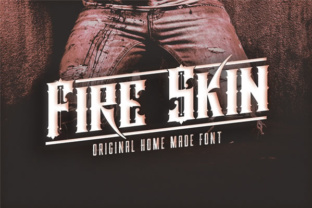
Fire Skin Font: A Bold Blackletter for Branding
I still remember the afternoon I sat in my studio, staring at a stack of plain white boxes intended for our new limited-edition candle line. The candles themselves were perfect—hand-poured, subtly scented with cedar and vanilla, and housed in sleek amber glass. But the branding? It felt invisible. I had been using a safe, rounded sans serif font for months because it was "easy to read." It was safe, yes, but it was also forgettable. In a market saturated with minimalist aesthetics, safe often means unseen. I needed something that would stop a scrolling thumb on Instagram or catch the eye of a shopper walking past a boutique shelf. That is when I discovered Fire Skin, a striking blackletter typeface from VMF Font that completely shifted how I approach visual identity.
For small business owners and creators, choosing a font is rarely just about aesthetics; it is about communication. Typography is the voice of your brand before a customer ever reads a single word. Fire Skin speaks with authority, history, and a touch of rebellious elegance. As a creative consultant who has helped dozens of entrepreneurs refine their brand identity, I have learned that the right display font can transform a generic product into a premium experience. This review explores how integrating a bold blackletter font like Fire Skin can elevate your packaging, digital presence, and overall brand perception.
The Personality of Gothic Elegance
Blackletter fonts, often referred to as Gothic script, carry a heavy cultural weight. They evoke medieval manuscripts, classic rock album covers, and high-fashion editorials. However, many traditional blackletter typefaces can feel too ornate or difficult to decipher on modern screens. Fire Skin strikes a remarkable balance. It retains the intricate, sharp angles and dense strokes characteristic of the genre but simplifies them just enough to remain legible in contemporary design contexts.
When I first tested Fire Skin on a mockup for a bakery’s sourdough packaging, the result was immediate. The font did not just sit on the label; it commanded attention. Its high-contrast strokes create a dramatic visual rhythm that feels both vintage and modern. For brands aiming to project qualities like craftsmanship, heritage, luxury, or edgy sophistication, this typeface is an invaluable asset. It moves beyond being mere text to become a graphic element in its own right. Whether you are designing a logo for a tattoo parlor, a header for a gothic-inspired jewelry line, or a title for a craft beer label, Fire Skin provides the gravitational pull needed to anchor your design.
Practical Applications in Brand Identity
The versatility of Fire Skin shines when applied to real-world business materials. While it is primarily a display font, meaning it is best used for headlines and short phrases rather than long paragraphs, its impact is profound in specific areas of brand identity.
- Packaging Design: On product labels, particularly for items like artisanal soaps, small-batch hot sauces, or premium skincare, Fire Skin adds a layer of perceived value. The intricate details of the letters suggest care and precision, mirroring the quality of the product inside.
- Social Media Graphics: In the fast-paced world of Instagram and Pinterest, static images need to pop. Using Fire Skin for quote graphics, sale announcements, or new collection drops creates a strong visual hook. It stands out against the clean, white backgrounds that dominate social feeds.
- Logo Design: For businesses wanting a memorable monogram or wordmark, this font offers distinct character. The sharp terminals and unique letterforms make for a recognizable logo that does not blend into the background.
- Print Collateral: Imagine thank-you cards included in online orders or menus in a cozy, dimly lit café. Fire Skin adds a tactile, editorial feel to these touchpoints, making the customer experience feel curated and special.
However, usage requires discretion. Because blackletter fonts are dense, they are not suitable for body copy. I always advise clients to use Fire Skin for titles, headers, and accent text, while pairing it with a highly readable secondary font for descriptions and details.
Mastering Readability and Font Pairing
The biggest challenge with any decorative typeface is readability. If a customer cannot read your product name within two seconds, the design has failed. Fire Skin is designed with clarity in mind, but it still demands respectful handling. When using this font on small labels, such as those on essential oil bottles or jewelry tags, ensure the size is large enough for the intricate details to remain distinct. Avoid using all caps for long words, as the uniform height can reduce legibility. Instead, use title case to leverage the natural variation in letter shapes.
Pairing is where the magic happens. To keep your design balanced, contrast the complexity of Fire Skin with simplicity. A clean, geometric sans serif font works beautifully as a companion. The neutrality of a sans serif allows the blackletter to shine without competing for attention. Alternatively, for a more romantic or vintage vibe, pair it with a delicate serif font. The key is hierarchy: let Fire Skin be the star, and let the supporting typography play the role of the reliable narrator.
For web design and digital ads, consider how the font renders on mobile devices. Test your designs on smaller screens to ensure the strokes do not blur together. Adjusting tracking (the space between letters) can also help open up the text, making it easier to scan quickly.
Investing in Professional Design Assets
As a business owner, treating your fonts as professional assets is crucial. Fire Skin is a commercial font, which means it is licensed for use in products you sell, client work, and marketing materials. Before downloading or purchasing any typeface, always review the licensing agreement. Understanding whether you need a desktop license, a web license, or an app license ensures you stay compliant and support the designers who create these tools.
VMF Font has crafted Fire Skin with attention to detail, including potential alternates and ligatures that can add further customization to your designs. Exploring these features can help you create unique logotypes or custom headings that no other brand can replicate. In a digital age where templates are ubiquitous, having access to distinctive design assets like Fire Skin gives your brand a competitive edge. It signals to customers that you care about the details, from the scent of your candle to the curve of your letterforms.
Ultimately, refreshing your brand with a powerful typeface like Fire Skin is not just about following a trend. It is about finding a visual language that authentically represents your business values. Whether you are launching a new product line or simply updating your Instagram bio, the right font can bridge the gap between your vision and your customer’s perception. By choosing bold, thoughtful typography, you invite your audience to see your brand not just as a vendor, but as a creator worth remembering.